
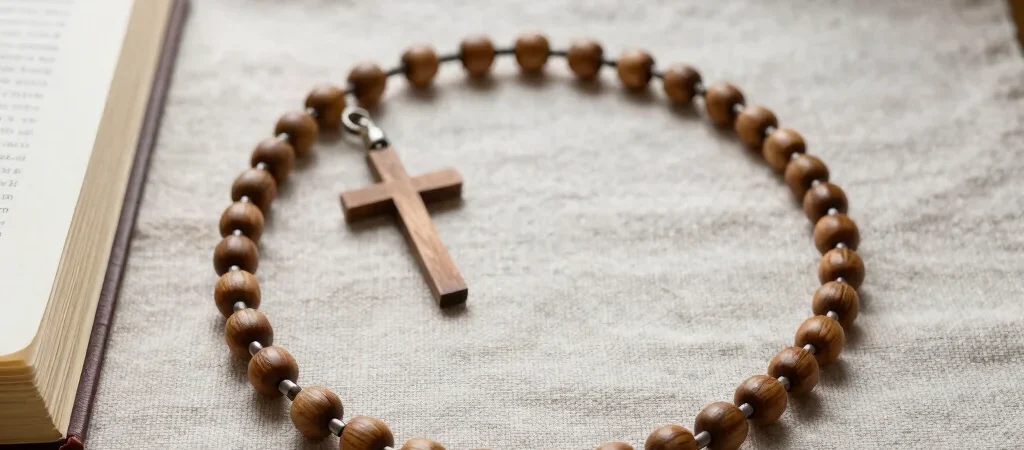
The first time you pick up a Rosary, the beads can look like a code: a cross, a short strand, then a loop of larger and smaller beads. The basic pattern is more approachable than it seems. I find it helpful to learn the movement first, without expecting every prayer or mystery to feel immediately familiar.
Follow the beads
A traditional Rosary begins with the Sign of the Cross and the Apostles’ Creed at the crucifix, followed by prayers on the opening beads. The loop is arranged in five groups called decades, each centered on a mystery for reflection. An Our Father begins each decade, followed by ten Hail Marys and a Glory Be.
Give each decade a focus
The mysteries are episodes from the lives of Jesus and Mary, grouped as the Joyful, Sorrowful, Glorious, and Luminous Mysteries. Many Catholics follow a customary weekly schedule, but a newcomer can simply choose one set and read a short description before praying. The beads keep count; the mystery gives the repeated prayers a subject to return to.
Start small and stay present
If a full Rosary feels like too much to begin with, try one decade and learn the prayers at an unhurried pace. It is normal to lose your place or find your thoughts wandering; gently returning to the next bead is part of the practice. A printed guide or a parish resource can help with the wording, while the rhythm becomes clearer through repetition.